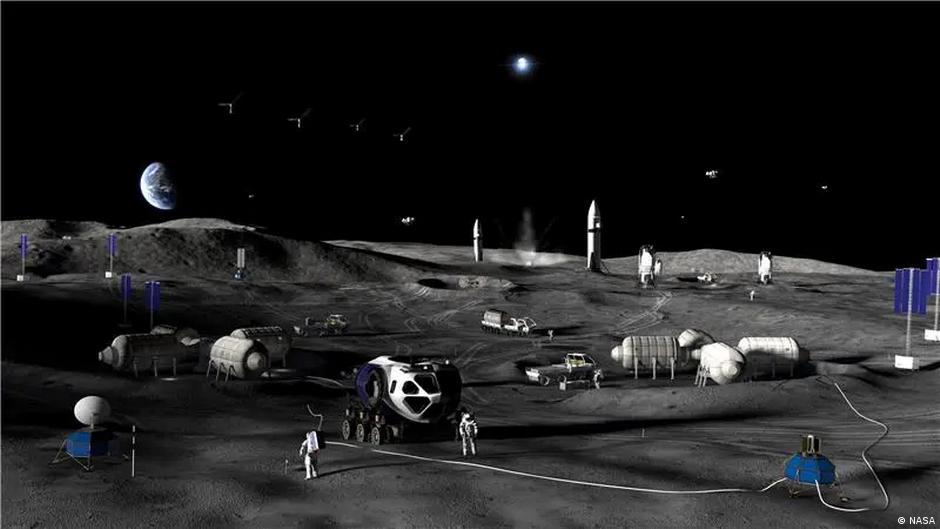





A Shift Away From Orbit
NASA awarded Intuitive Machines a $180.4 million contract to deliver lunar payloads. This contract is part of a shift to prioritize building a moon base over the Lunar Gateway space station. The contract reflects Administrator Jared Isaacman's decision to abandon plans for an orbiting lunar station and redirect resources toward building a surface base instead.
Isaacman, sworn in at NASA in December, announced the pivot during an event called "Ignition" at the agency's Washington headquarters. The Lunar Gateway station, much of which had already been built by contractors Northrop Grumman and Lanteris Space Systems, was originally designed to orbit the moon and serve as a base of operations for astronauts to shuttle to and from the surface.
"It should not really surprise anyone that we are pausing Gateway in its current form and focusing on infrastructure that supports sustained operations on the lunar surface," Isaacman told delegates at the event.
A $20 Billion Moon Base Over Seven Years
NASA plans to construct a roughly $20 billion base on the moon's surface over the next seven years, structured in three phases. Each phase will cost on the order of $10 billion and rely on a scaled-up Commercial Lunar Payload Services program to deliver equipment and supplies.
The first phase, running through 2028, involves 21 landings placing 4 metric tons of payload on the moon. This phase includes the VIPER rover to prospect for lunar resources, four "Moon Fall" drones capable of traveling up to 50 kilometers to reach difficult terrain, and initial lunar terrain vehicles designed to survive up to 150 hours without sunlight. NASA will also establish two lunar orbital communications satellite constellations during this phase.
Phase two, from 2029 to 2032, comprises 27 landings delivering 60 metric tons total. These payloads will include larger pressurized rovers, solar and nuclear power sources, communication towers, and excavator rovers to help secure a permanent base site.
Long-Term Habitation and Manufacturing
The final phase, from 2032 to 2036, will establish habitats for sustained human presence. Over 28 landings, NASA plans to place 150 metric tons of payload on the surface, including fission power systems, multiple rovers, and an "industrial neighborhood" to support in-situ manufacturing. This phase will support four astronauts for four-week missions and enable the return of hundreds of kilograms to Earth, including scientific experiments and lunar materials.
Carlos Garcia-Galan, formerly a deputy program manager for Gateway, now leads the Moon Base initiative. He emphasized the shift in focus during an interview after the announcement, saying the Gateway team would redirect their energy toward surface operations. "Everyone wants to be on the surface," Garcia-Galan said.
Accountability and Competition
Isaacman framed the lunar base as essential to maintaining American leadership in space exploration. He told contractors that NASA expects better performance and will not tolerate schedule delays or budget overruns. "We are not going to sit idly by while schedules slip or budgets are exceeded," he said. "Expect uncomfortable action if that is what it takes."
Isaacman stated that the public has invested $100 billion in space programs and deserves accountability for the results. The urgency reflects competition from China, which aims to land on the orb in 2030, and from Russia and China jointly, which plan to develop an International Lunar Research Station by 2036.
Isaacman outlined a plan for a nuclear-powered mission to Mars that will release three helicopters there. The lunar base, however, remains the immediate focus. With Intuitive Machines now contracted to deliver payloads and three phases of development mapped out through 2036, NASA has established a concrete timeline for sustained human operations on the lunar surface.