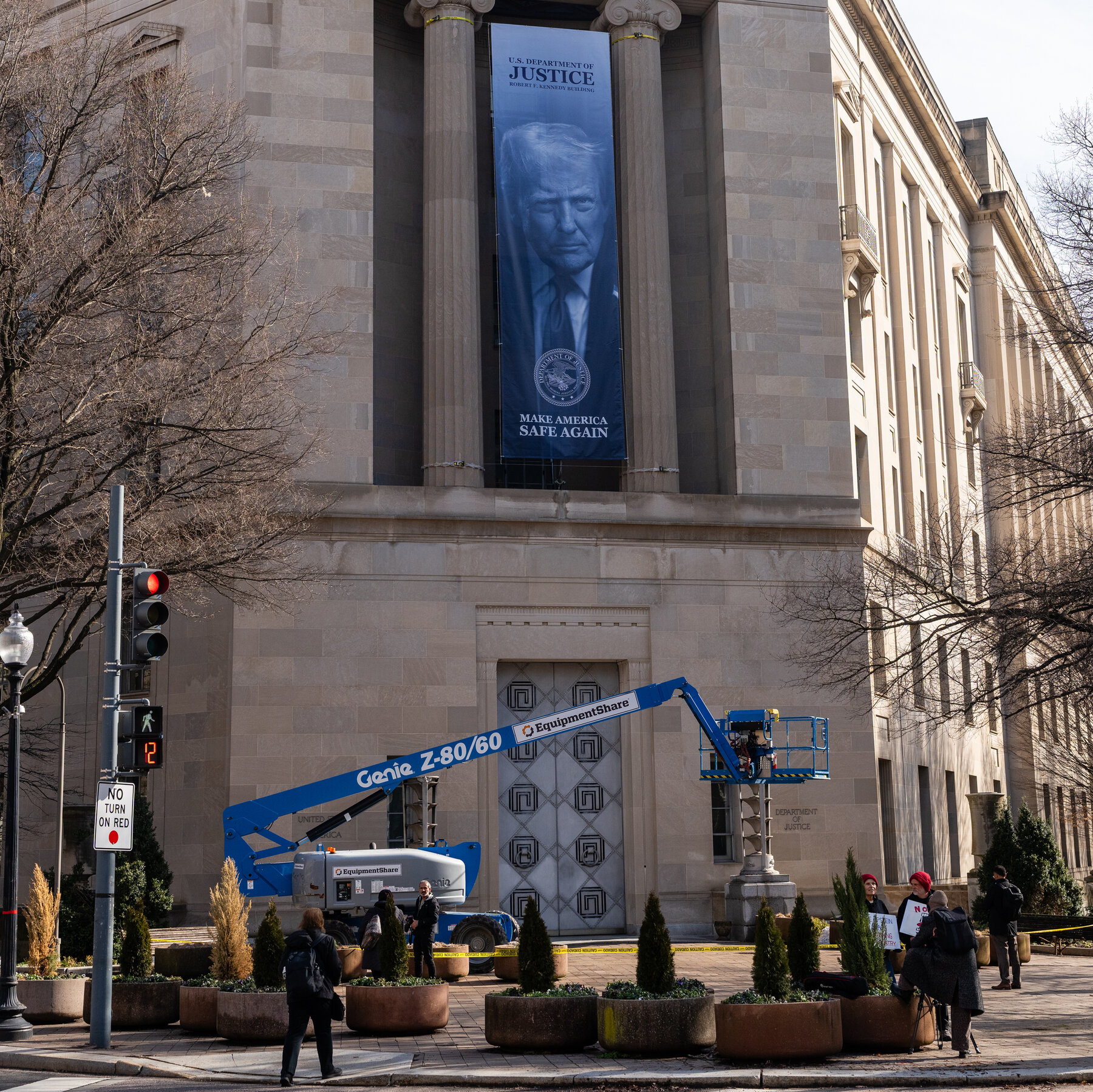
The Department of Justice abandoned its defense of President Trump's executive orders targeting four major law firms on Monday, ending a legal battle in which four federal district judges had ruled against the orders. Lawyers for the DOJ moved to voluntarily dismiss all four pending appeals, according to court filings. The move signals the administration will not pursue the orders further.
Four different federal judges ruled against President Trump's executive orders targeting the law firms, according to court filings. The orders targeted Perkins Coie, WilmerHale, Jenner & Block, and Susman Godfrey. Each ruling came from a separate district court.
The executive orders targeted Perkins Coie, WilmerHale, Jenner & Block, and Susman Godfrey, though the sources do not specify the exact provisions of the orders. According to the New York Times, the threat of the executive orders led law firms to submit to the president rather than face potential enforcement action. The DOJ's decision to stop fighting means those firms no longer face the prospect of new legal battles, though the underlying orders remain in place.
The four firms targeted represent clients across industries, government, and politics. Federal contracts represent significant business for major law firms.
By dropping the appeals, the DOJ will not pursue further litigation on these orders. The executive orders themselves remain in place, though the DOJ is no longer defending them in court. The legal landscape has shifted in favor of the law firms that faced the orders.
The Department of Justice abandoned its defense of President Trump's executive orders targeting four major law firms on Monday, ending a legal battle that had already failed in every courtroom. Lawyers for the DOJ moved to voluntarily dismiss all four pending appeals, according to court filings. The move signals the administration will not pursue the orders further, even as those firms continue operating under the threat of potential future action.
Four different federal judges had already ruled the executive orders unconstitutional. The orders targeted Perkins Coie, WilmerHale, Jenner & Block, and Susman Godfrey. Each ruling came from a separate district court, creating a legal wall the administration decided not to climb.
The executive orders sought to bar these firms from federal work and contracts. The threat alone had already pushed many law firms to comply with the administration's demands rather than risk losing government business. The DOJ's decision to stop fighting means those firms no longer face the prospect of new legal battles, though the underlying orders remain in place.
The four firms targeted are among the nation's largest and most influential. They represent clients across industries, government, and politics. Losing access to federal work would have meant millions in lost revenue and reduced influence in Washington.
By dropping the appeals, the administration effectively concedes that federal judges will not uphold these orders. The executive orders themselves remain on the books, but without legal defense, they cannot be enforced through the courts. Law firms that had altered their practices or client relationships in response to the threat now face uncertainty about whether those changes were necessary.
The decision leaves unresolved whether the administration might attempt new executive orders with different language targeting the same firms. For now, the legal landscape has shifted decisively in favor of the law firms that faced the orders.
Highlighted text was flagged by the council. Tap to see feedback.