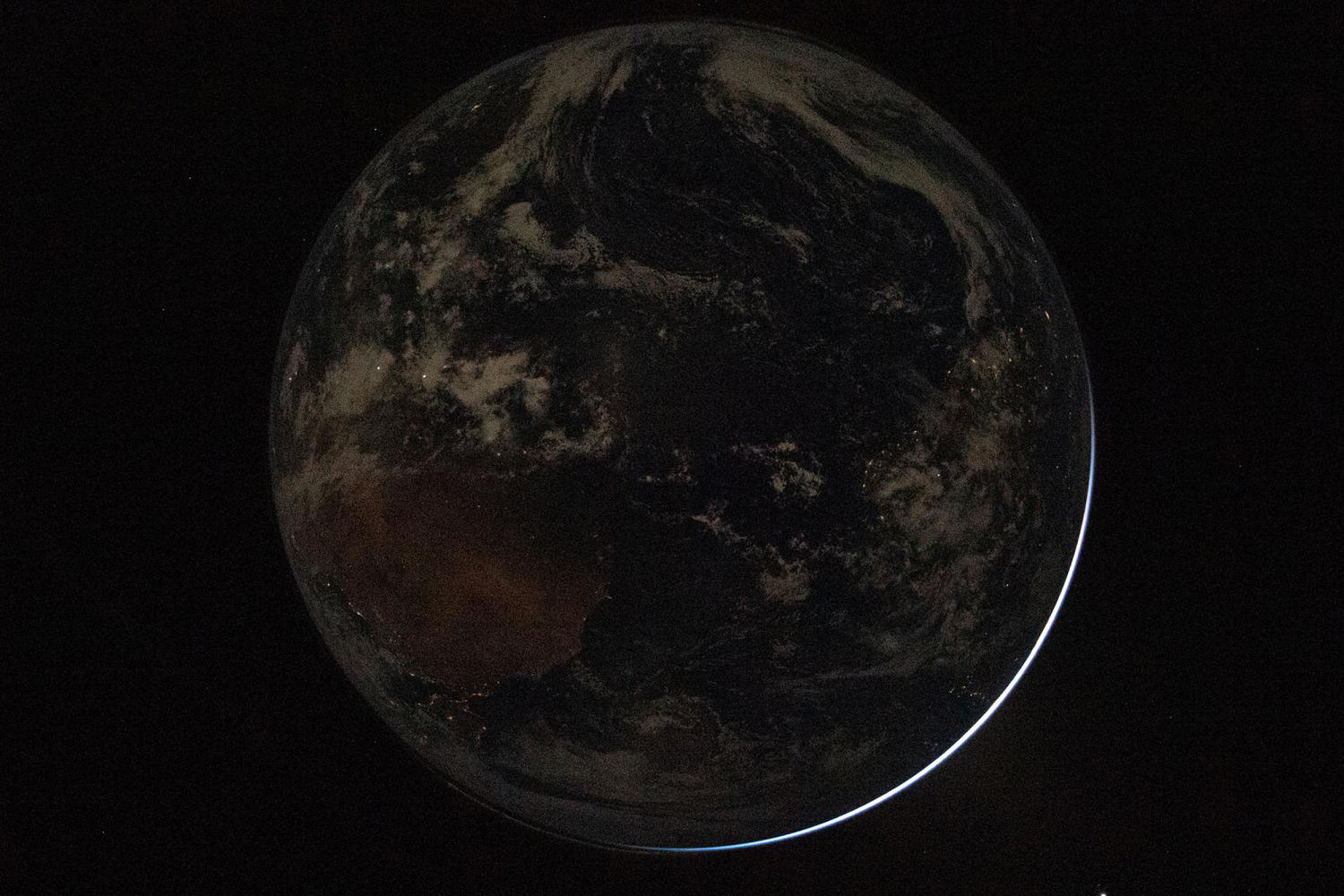
Commander Reid Wiseman aimed his camera through Orion's window at 2:30 a.m. Friday and captured an image so striking it halted conversation inside the spacecraft. The photograph shows Earth backlit by the sun, with green auroras glowing at both poles and zodiacal light streaking across the bottom right corner. "It was the most spectacular moment, and it paused all four of us in our tracks," Wiseman told mission control during a live TV interview.
The crew reached the halfway point to the moon at precisely two days, five hours and 24 minutes after Wednesday's launch from Cape Canaveral. According to the BBC, Orion's dashboard showed the spacecraft 142,000 miles from Earth and 132,000 miles from the moon at 7:00 a.m. BST Friday. NASA's Lakiesha Hawkins confirmed the crew now travels on a "free-return" trajectory that will use lunar gravity to slingshot them back toward Earth without requiring additional propulsion.
The astronauts spent their first day in space troubleshooting a malfunctioning toilet, which Christina Koch called "probably the most important piece of equipment on board." After declaring herself the mission's space plumber, Koch reported the crew "were all breathing a sigh of relief when it turned out to be just fine." They also resolved a communications issue and began their mandatory 30-minute daily exercise routines to combat muscle and bone loss in zero gravity. The crew reported cabin temperatures dropped to the mid-60s after flight controllers turned off several shell heaters, prompting adjustments to maintain comfort during the 10-day mission.
Monday's lunar flyby could push the crew farther from Earth than any humans in history, potentially surpassing Apollo 13's 1970 record of 248,655 miles. Unlike Apollo 13's crisis-driven extended journey, Artemis II follows a planned path that will return the crew to Pacific waters Friday, April 10.
NASA's Howard Hu dismissed concerns about a helium system issue in Orion's service module, noting the primary regulator has completed its required burns and a backup system functions normally. Flight director Judd Frieling characterized environmental sensor false alarms as "conservative limits" that pose no crew danger but will inform adjustments for Artemis III. Flight director Judd Frieling said the crew found a comfortable humidity level between "desert dry" and "Houston humid," as carbon dioxide scrubbers operate more efficiently with proper moisture content.
Wiseman's second released image shows Earth divided by its terminator line, the boundary between day and night, while another captures the planet's city lights twinkling in near-complete darkness. The Atlantic Ocean dominates the frame in "Hello, World," NASA's title for the first image, with the western Sahara and Iberian peninsula visible alongside eastern South America. Venus appears as a bright spot in the lower right corner of the aurora image, providing a celestial reference point for the unprecedented perspective. The crew's enthusiasm for photography left Orion's windows smeared enough that Wiseman had to ask Houston for cleaning instructions.
Commander Reid Wiseman aimed his camera through Orion's window at 2:30 a.m. Friday and captured an image so striking it halted conversation inside the spacecraft. The photograph shows Earth backlit by the sun, with green auroras glowing at both poles and zodiacal light streaking across the bottom right corner. "It was the most spectacular moment, and it paused all four of us in our tracks," Wiseman told mission control during a live TV interview. NASA released the image Friday afternoon, marking humanity's first new view of Earth from deep space since 1972.
The crew reached the halfway point to the moon at precisely two days, five hours and 24 minutes after Wednesday's launch from Cape Canaveral. Orion's dashboard showed the spacecraft 142,000 miles from Earth and 132,000 miles from the moon at 7:00 a.m. BST Friday. NASA's Lakiesha Hawkins confirmed the crew now travels on a "free-return" trajectory that will use lunar gravity to slingshot them back toward Earth without requiring additional propulsion. The spacecraft maintains a cruising speed that will bring it within 60 miles of the lunar surface Monday afternoon.
The astronauts spent their first day in space troubleshooting a malfunctioning toilet, which Christina Koch called "probably the most important piece of equipment on board." After declaring herself the mission's space plumber, Koch reported the crew "were all breathing a sigh of relief when it turned out to be just fine." They also resolved a communications issue and began their mandatory 30-minute daily exercise routines to combat muscle and bone loss in zero gravity. The crew reported cabin temperatures dropped to the mid-60s after flight controllers turned off several shell heaters, prompting adjustments to maintain comfort during the 10-day mission.
Monday's lunar flyby could push the crew farther from Earth than any humans in history, potentially surpassing Apollo 13's 1970 record of 248,655 miles. The current mission profile carries Victor Glover, Christina Koch, Reid Wiseman and Canadian astronaut Jeremy Hansen beyond the Apollo 13 trajectory without the complications that forced Jim Lovell's crew to abort their lunar landing. Unlike Apollo 13's crisis-driven extended journey, Artemis II follows a planned path that will return the crew to Pacific waters Friday, April 10.
NASA's Howard Hu dismissed concerns about a helium system issue in Orion's service module, noting the primary regulator has completed its required burns and a backup system functions normally. Flight director Judd Frieling characterized environmental sensor false alarms as "conservative limits" that pose no crew danger but will inform adjustments for Artemis III. The spacecraft's humidity levels now balance between "desert dry" and "Houston humid" after engineers fine-tuned the carbon dioxide scrubbers, which operate more efficiently with proper moisture content.
Wiseman's second released image shows Earth divided by its terminator line, the boundary between day and night, while another captures the planet's city lights twinkling in near-complete darkness. The Atlantic Ocean dominates the frame in "Hello, World," NASA's title for the first image, with the western Sahara and Iberian peninsula visible alongside eastern South America. Venus appears as a bright spot in the lower right corner of the aurora image, providing a celestial reference point for the unprecedented perspective. The crew's enthusiasm for photography left Orion's windows smeared enough that Wiseman had to ask Houston for cleaning instructions.
Highlighted text was flagged by the council. Tap to see feedback.














































For example, the NBC News source does not mention the BBC or specific distances like 142,000 miles from Earth.