
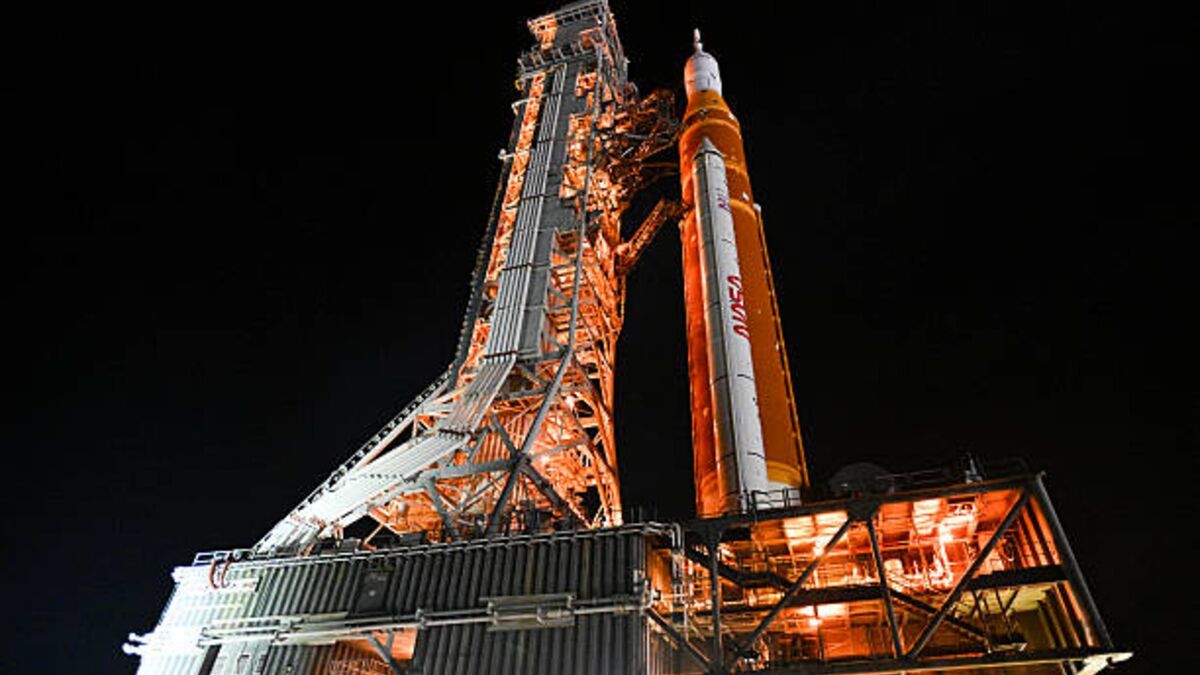





The Mission Launches Wednesday
NASA will launch four astronauts toward the moon on Wednesday, April 1, at 6:24 p.m. EDT aboard the Space Launch System rocket, the most powerful operational booster in the world. Commander Reid Wiseman, pilot Victor Glover, astronaut Christina Koch, and Canadian astronaut Jeremy Hansen will travel in an Orion capsule on a nine-day journey around the moon and back. Forecasters predict an 80% chance of acceptable weather for launch.
"Hey, let's go to the moon!" Wiseman exclaimed to reporters after arriving at Kennedy Space Center on Friday. "I think the nation and the world has been waiting a long time to do this again." This will be the first crewed flight of the Space Launch System and the first piloted flight of the Orion deep space crew capsule, following the uncrewed Artemis I test flight in 2022. No astronaut has ventured to the moon since the Apollo 17 mission more than 50 years ago.
How the Mission Works
The crew will not land on the moon or enter lunar orbit. Instead, they will follow a free return trajectory, flying around the moon's leading edge and using lunar gravity to bend the ship's path back toward Earth. The spacecraft will pass within about 4,100 miles of the moon's surface at closest approach. At that distance, lead flight director Jeff Radigan explained, "If you held a basketball out from your hand and you looked at it, that's about how big the moon will appear in the crew's window."
After launch, the Orion capsule will spend about 24 hours in orbit around Earth, allowing the crew to test critical systems including communications, navigation, propulsion, and life support. Wiseman told CBS News that the crew must verify whether the capsule can scrub carbon dioxide, keep them alive, provide drinking water, and handle basic human functions before heading to the moon. A trans-lunar injection burn about 25 hours after launch will boost the ship's velocity by roughly 900 mph, pushing it out of Earth's orbit for the four-day coast to the moon.
The astronauts will become the first humans to see large regions of the moon's far side. Assuming an April 1 launch, 21% of the far side will be in sunlight when they pass, giving them a chance to directly observe portions never before seen by human eyes. Christina Koch said the crew has planned a "highly choreographed dance" of who will hold cameras and recording devices to capture observations of areas that remote sensing satellites have imaged but human eyes have never witnessed.
The Heat Shield Challenge
The Artemis II Orion uses the same type heat shield as the unpiloted Artemis I mission in 2022, but NASA engineers made critical changes after discovering problems. During Artemis I's reentry, the heat shield suffered unexpected damage, with large chunks of the outer char layer popping off. Post-flight analysis revealed that high entry heating made the outer layer permeable, allowing gases from lower layers to escape. During the skip trajectory used in Artemis I, entry heating lessened, the outer layer became impermeable, and pressure built up, pushing chunks away.
Engineers determined that a different entry trajectory would allow the outer char layer to erode more evenly without creating damaging cracks. NASA Associate Administrator Amit Kshatriya said that given the free return trajectory, "we can safely, and with high degrees of success, control that entry environment." An independent review team agreed with these conclusions, and NASA managers opted to keep the heat shield in place rather than replace it.
The Return to Earth
The crew will splash down in the Pacific Ocean on April 10 after traveling approximately 252,000 miles from Earth, beating the Apollo 13 record distance of 248,655 miles by about 4,000 miles. During reentry, the Orion capsule will reach speeds of roughly 25,000 mph, or 7 miles per second. The 16.5-foot-wide heat shield will endure temperatures as high as 5,000 degrees and block radio signals for about five minutes.
Nine minutes after reentry begins, the crew will deploy 11 parachutes, the most complex parachute system ever flown on a piloted spacecraft. Three small parachutes will deploy at about 36,000 feet, followed by two 23-foot-wide drogue chutes at around 24,000 feet to stabilize the capsule. Three 116-foot-wide main parachutes will then inflate in stages between 8,000 and 4,000 feet, slowing the descent from roughly 300 mph to a splashdown velocity of 15 to 17 mph. The entire reentry process, from atmospheric entry to splashdown, will take 13 minutes.
Why This Matters for Future Missions
This test flight paves the way for NASA's broader lunar ambitions. The mission represents a shift in strategy from the Apollo era. "But this time, the goal is not flags and footprints. This time, the goal is to stay," NASA Administrator Jared Isaacman said. "America will never again give up the moon."
The competition with China drives the urgency. China plans to land its own astronauts on the moon by 2030. NASA hopes to win that race by launching one or possibly two Artemis moon landing missions in 2028. Beyond lunar exploration, the spacesuits worn on Artemis II are ultimately designed for use in future Mars transit missions, making this mission a stepping stone to deeper space exploration.





















The sources also report that Jeremy Hansen, the Canadian astronaut on the Artemis II mission, will become the first Canadian to leave Earth orbit.