




Historic return marks turning point for lunar exploration
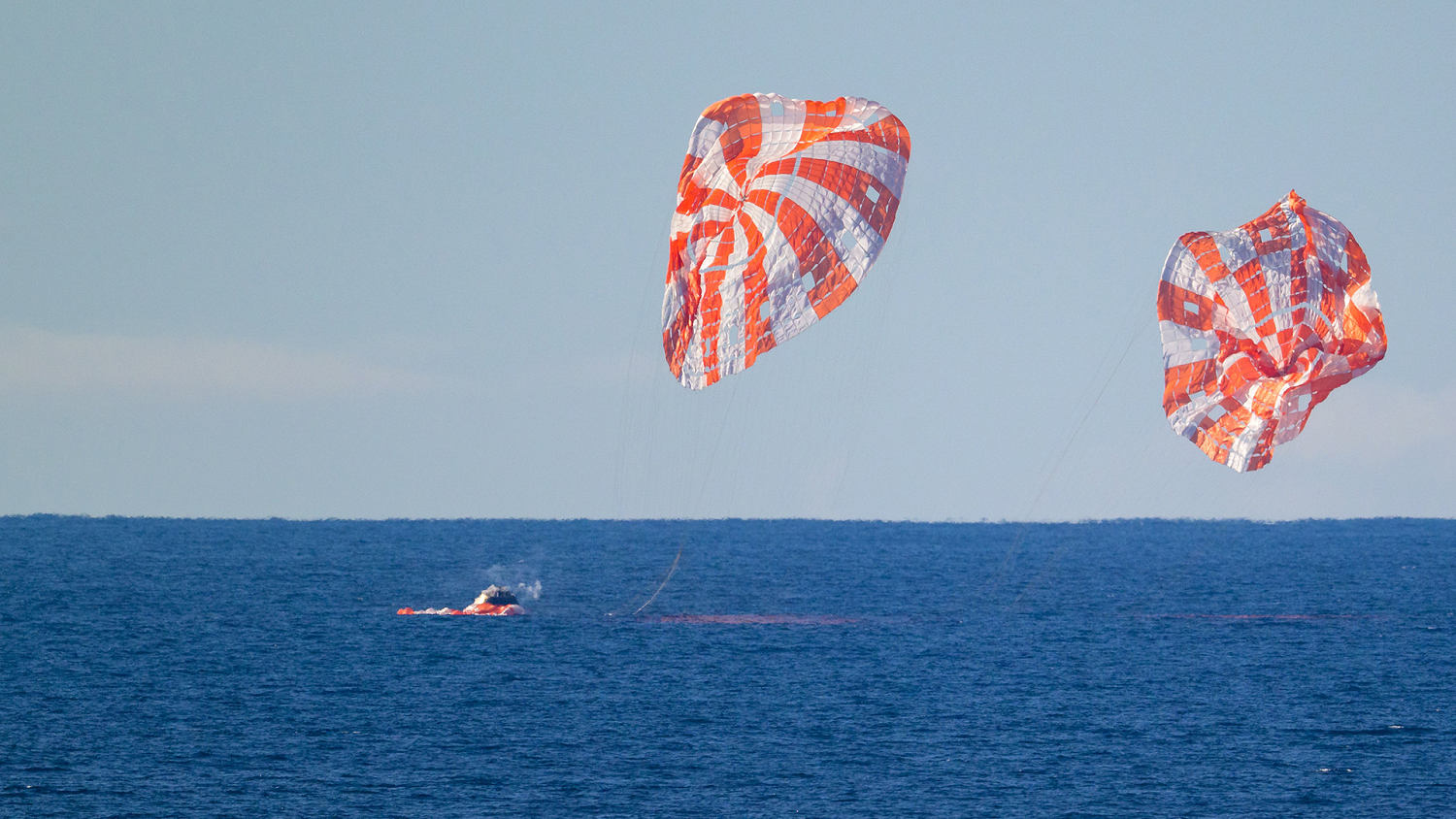
Four astronauts splashed down in the Pacific Ocean off San Diego at 8:07 p.m. Friday, completing the first crewed lunar flyby in more than 50 years. Commander Reid Wiseman, pilot Victor Glover, and mission specialist Christina Koch of NASA, along with Canadian Space Agency astronaut Jeremy Hansen, traveled 695,081 miles over 10 days and ventured farther from Earth than any humans before them. The successful return signals that NASA has cleared a critical hurdle in its plan to land crews on the moon's surface by 2028.
The Orion capsule endured extreme conditions during reentry. The spacecraft slowed from nearly 25,000 miles per hour—more than 30 times the speed of sound—while withstanding predicted temperatures of about 5,000 degrees Fahrenheit, according to NASA. Victor Glover described the roughly 13-minute journey from the top of the atmosphere to the surface as "riding a fireball through the atmosphere," though he emphasized the necessity of the maneuver. "We have to get back. There's so much data that you've seen already, but all the good stuff is coming back with us," Glover said before the descent.
Recovery and crew condition
All four astronauts exited the Orion capsule and were hoisted one by one into Navy helicopters that transported them to the USS John P. Murtha. A burst of applause and cheers erupted in NASA's Mission Control Center as the first crew member emerged. The astronauts were described as "happy and healthy" and in "stable" condition following their splashdown.
NASA astronaut Dr. Kjell Lindgren, watching from the recovery zone with the crew's families and friends, called the splashdown "picture perfect." The astronauts spent time on an inflatable raft known as the "front porch" to readjust to Earth's gravity before their helicopter extraction.
What comes next
At a press conference following the splashdown, NASA officials declared a new chapter opening for human spaceflight. Amit Kshatriya, associate NASA administrator, said the mission's success means "the path to the lunar surface is open," though he cautioned that hard work remains. "Fifty-three years ago, humanity left the moon. This time we returned to stay. Let us finish what they started. Let us not go to plant flags and leave—but to stay," Kshatriya said.
Howard Hu, NASA Orion program manager, framed the moment more broadly. "This is the start of a new era of human space exploration," Hu said. NASA plans to land a crew on the moon's surface with the Artemis IV mission by 2028, building directly on the data and experience gained from Artemis II's journey around the far side of the moon.