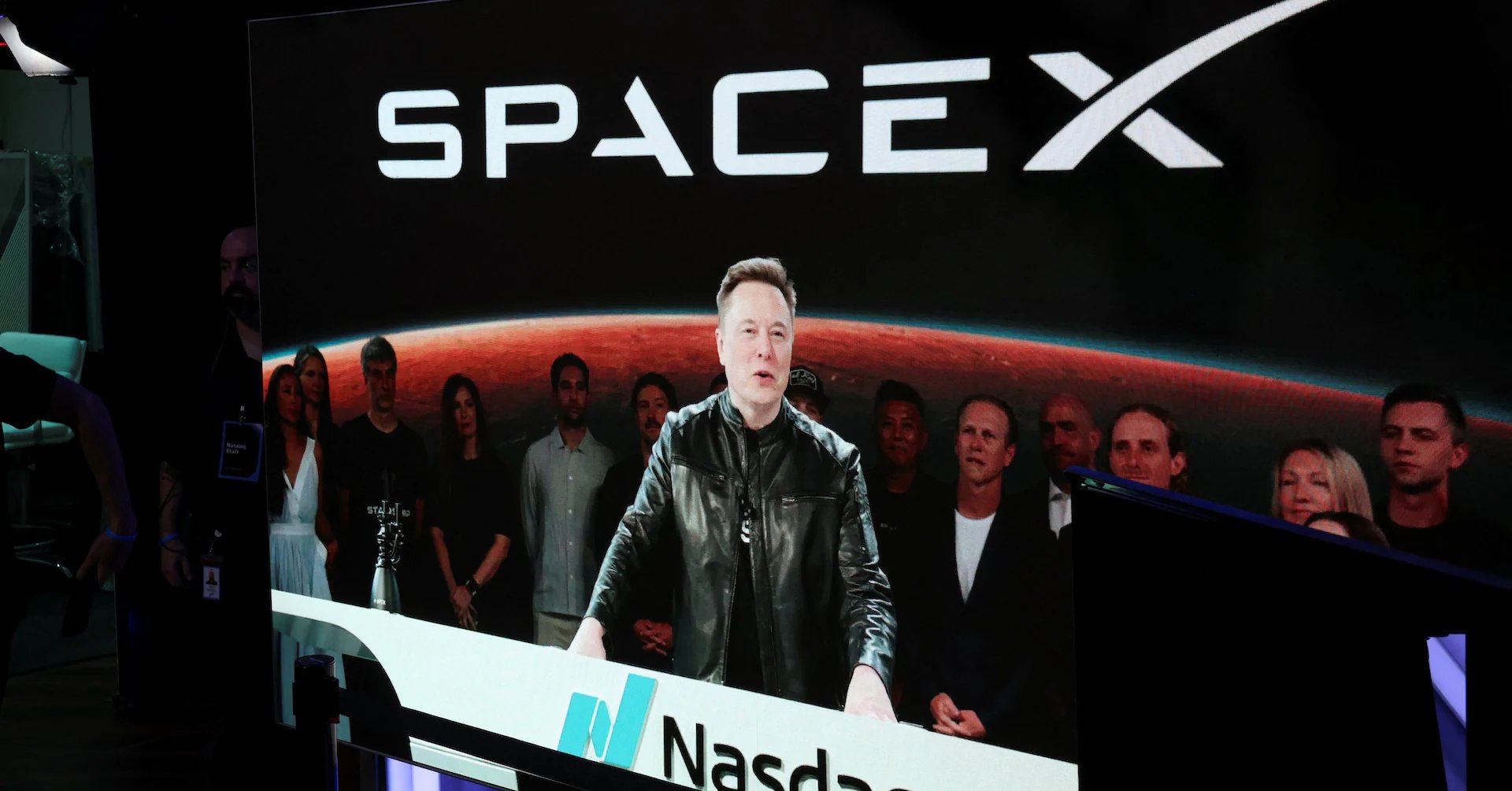
SpaceX completed the largest initial public offering in history on Friday, raising $75 billion and immediately vaulting into the ranks of the world's most valuable companies. The company priced 555 million shares at $135 each on the Nasdaq under the ticker symbol SPCX, surpassing the previous record set by Saudi Aramco's 2019 offering of nearly $26 billion.
Shares opened at $150 and closed at $160.95, a gain of 19% from the IPO price. During intraday trading, the stock peaked at $176.52, a jump of nearly 31% from the offering price. The offering generated extraordinary investor appetite, with Bloomberg reporting more than $100 billion in retail orders before trading began.
SpaceX's market value reached $2.2 trillion at closing, ranking it ahead of Meta Platforms, Samsung, and Elon Musk's own Tesla. Only Nvidia, valued at nearly $5 trillion, and a handful of other tech companies surpass it.
Juan Hernandez joined SpaceX as a welder in 2015 after a friend recommended him for the job. He had never heard of the company before that conversation. When hired, SpaceX offered him $10,000 worth of stock, an offer he did not initially value. "I didn't know anything about it then," he told CBS News. "I didn't know it was gonna be this big, at this point."
Over a decade, Hernandez rose through the ranks to become a supervisor, building and preparing rocket structures for launch. His roughly 6,500 shares closed Friday at $160.95 each, valuing his holdings at $1,046,175. Hernandez now works at Blue Origin, Jeff Bezos's rocket startup, but his SpaceX equity transformed his financial future. He is teaching his three children, including his 16-year-old daughter, how to invest based on lessons learned from owning company stock. She already holds shares in Meta and several other companies.
Elon Musk became the world's first trillionaire following SpaceX's IPO pricing. Before the offering, his net worth stood at approximately $813 billion, more than twice that of Google co-founder Larry Page, valued at $288 billion. The IPO pricing boosted his fortune to just over $1 trillion, and at the closing price of $160.95, his wealth reached roughly $1.14 trillion.
Musk owns 4.8 billion SpaceX shares, representing about 42% of the company, plus 350 million stock options exercisable at $8.39 per share. His stake was valued at $648 billion at the IPO price, with options adding another $44.3 billion. Forbes had valued his pre-IPO SpaceX holdings at $500 billion, meaning the public offering increased that stake's value by $192.3 billion.
Only 19 countries have gross domestic products exceeding $1 trillion, according to World Bank data. Oxfam America senior director of economic justice Nabil Ahmed called Musk's rise "a new pinnacle of oligarchy," describing it as marking a "new Gilded Age" of wealth inequality.
SpaceX trades at 90 times its sales, a valuation divorced from underlying business fundamentals, according to Adam Johnson, portfolio manager at the Bullseye American Ingenuity Fund. The company booked $18.7 billion in revenue last year but remains unprofitable, having lost $8.7 billion between the start of 2025 and March 31. By contrast, Alphabet, Apple, and Nvidia each produce annual after-tax profits exceeding $100 billion.
Jay Ritter, an IPO expert at the University of Florida's Warrington College of Business, noted that SpaceX's opening price was "disappointing relative to what betting markets had been predicting," though still positive since trading exceeded the initial offer price. "If the stock price holds, there will be more dollar value of early stock returns than any IPO in history," Ritter told CBS News.
A Truist analysis of 30 large technology IPOs found that more than half posted negative returns one year after shares began trading. However, Isabelle Freidheim, founder of Athena Capital, noted that the top-performing companies in the S&P 500 trade at premiums to earnings, a dynamic exacerbated by enthusiasm around artificial intelligence. "Hype is a borrowing, if you will, in the short term against future performance, so some companies will repay it," she told Axios.
SpaceX raised $75 billion to finance its ambitious plans, which include establishing a human colony on Mars and deploying solar-powered data centers in space. SpaceX said it sees a market opportunity exceeding $28 trillion across its operating industries. Of that, 90% is attributed to xAI alone, according to analysis by Van Ha Trinh, financial markets analyst at Exness.
SpaceX shares are expected to be added to several indexes in the coming days, including the Nasdaq 100 and Russell indices. This inclusion could allow millions of Americans with 401(k) plans and index funds to become shareholders without making individual purchases. About 4,400 SpaceX workers could become millionaires from the IPO, according to the New York Times, though Musk remains the largest beneficiary given his controlling stake and 82.4% of the company's voting power.
SpaceX completed the largest initial public offering in history on Friday, raising $75 billion and immediately vaulting into the ranks of the world's most valuable companies. The company priced 555 million shares at $135 each on the Nasdaq under the ticker symbol SPCX, surpassing the previous record set by Saudi Aramco's 2019 offering of nearly $26 billion.
Shares opened at $150 and closed at $160.95, a gain of 19% from the IPO price. During intraday trading, the stock peaked at $176.52, a jump of nearly 31% from the offering price. The offering generated extraordinary investor appetite, with Bloomberg reporting more than $100 billion in retail orders before trading began.
SpaceX's market value reached $2.2 trillion at closing, ranking it ahead of Meta Platforms, Samsung, and Elon Musk's own Tesla. Only Nvidia, valued at nearly $5 trillion, and a handful of other tech companies surpass it.
Juan Hernandez joined SpaceX as a welder in 2015 after a friend recommended him for the job. He had never heard of the company before that conversation. When hired, SpaceX offered him $10,000 worth of stock, an offer he did not initially value. "I didn't know anything about it then," he told CBS News. "I didn't know it was gonna be this big, at this point."
Over a decade, Hernandez rose through the ranks to become a supervisor, building and preparing rocket structures for launch. His roughly 6,500 shares closed Friday at $160.95 each, valuing his holdings at $1,046,175. Hernandez now works at Blue Origin, Jeff Bezos's rocket startup, but his SpaceX equity transformed his financial future. He is teaching his three children, including his 16-year-old daughter, how to invest based on lessons learned from owning company stock. She already holds shares in Meta and several other companies.
Elon Musk became the world's first trillionaire following SpaceX's IPO pricing. Before the offering, his net worth stood at approximately $813 billion, more than twice that of Google co-founder Larry Page, valued at $288 billion. The IPO pricing boosted his fortune to just over $1 trillion, and at the closing price of $160.95, his wealth reached roughly $1.14 trillion.
Musk owns 4.8 billion SpaceX shares, representing about 42% of the company, plus 350 million stock options exercisable at $8.39 per share. His stake was valued at $648 billion at the IPO price, with options adding another $44.3 billion. Forbes had valued his pre-IPO SpaceX holdings at $500 billion, meaning the public offering increased that stake's value by $192.3 billion.
Only 19 countries have gross domestic products exceeding $1 trillion, according to World Bank data. Oxfam America senior director of economic justice Nabil Ahmed called Musk's rise "a new pinnacle of oligarchy," describing it as marking a "new Gilded Age" of wealth inequality. The organization noted that Musk's wealth now exceeds that of the bottom 46% of the world's population, or approximately 3.8 billion people.
SpaceX trades at 90 times its sales, a valuation divorced from underlying business fundamentals, according to Adam Johnson, portfolio manager at the Bullseye American Ingenuity Fund. The company booked $18.7 billion in revenue last year but remains unprofitable, having lost $8.7 billion between the start of 2025 and March 31. By contrast, Alphabet, Apple, and Nvidia each produce annual after-tax profits exceeding $100 billion.
Jay Ritter, an IPO expert at the University of Florida's Warrington College of Business, noted that SpaceX's opening price was "disappointing relative to what betting markets had been predicting," though still positive since trading exceeded the initial offer price. "If the stock price holds, there will be more dollar value of early stock returns than any IPO in history," Ritter told CBS News.
A Truist analysis of 30 large technology IPOs found that more than half posted negative returns one year after shares began trading. Historically, the majority of companies going public underperform the market in their first three years. However, Isabelle Freidheim, founder of Athena Capital, noted that the top-performing companies in the S&P 500 trade at premiums to earnings, a dynamic exacerbated by enthusiasm around artificial intelligence. "Hype is a borrowing, if you will, in the short term against future performance, so some companies will repay it," she told Axios.
SpaceX plans to use the $75 billion to finance ambitious projects including establishing a human colony on Mars and deploying solar-powered data centers in space. The company sees a market opportunity exceeding $28 trillion across its operating industries, with 90% attributed to its xAI division alone, according to analysis by Van Ha Trinh, financial markets analyst at Exness.
SpaceX shares are expected to be added to several indexes in the coming days, including the Nasdaq 100 and Russell indices. This inclusion could allow millions of Americans with 401(k) plans and index funds to become shareholders without making individual purchases. About 4,400 SpaceX workers could become millionaires from the IPO, according to the New York Times, though Musk remains the largest beneficiary given his controlling stake and 82.4% of the company's voting power.
Highlighted text was flagged by the council. Tap to see feedback.